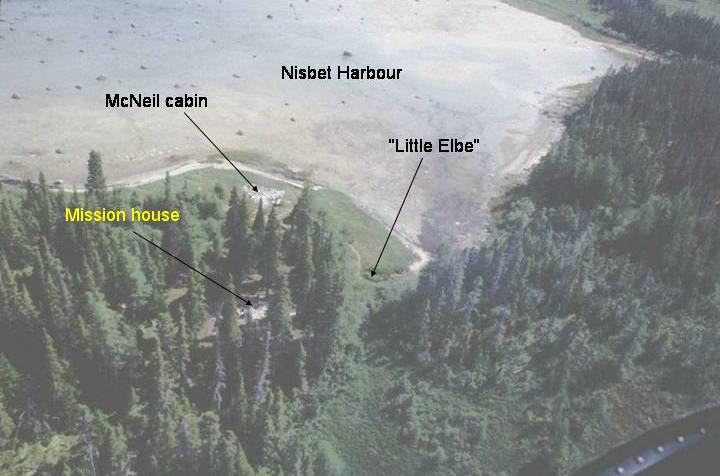
The construction was of large slabs of local stone measuring upwards of 60 cm by 40 cm, with smaller rocks used to fill gaps in the masonry. The foundation stones on the interior were left rough cut, but the exterior side had a square, net face.
Entrance into the house was through a set of stairs on the west front of the foundations. Four steps of large stone slabs were supported on one side by sand fill, and on the other by a ramp formed of irregular-shaped stone. This ramp may have been used to roll heavy supply barrels up to the doorway.
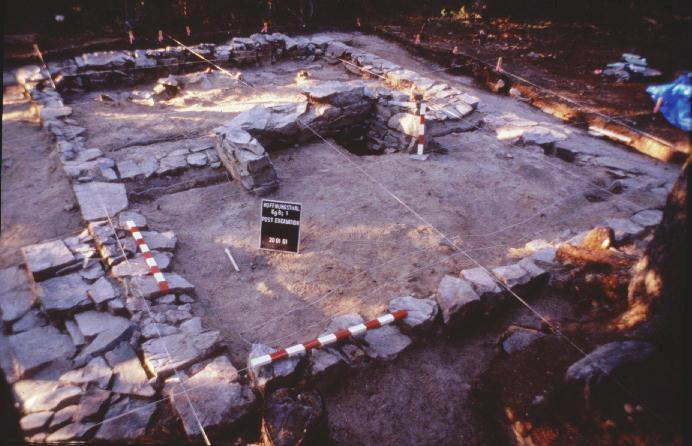
The Hoffnungsthal mission station after excavation, facing northeast. The hearth is clearly visible in the centre and the stone steps and ramp can be seen in the foreground. The remains of the floor joists have been outlined with white string. (Photo by H. Cary).
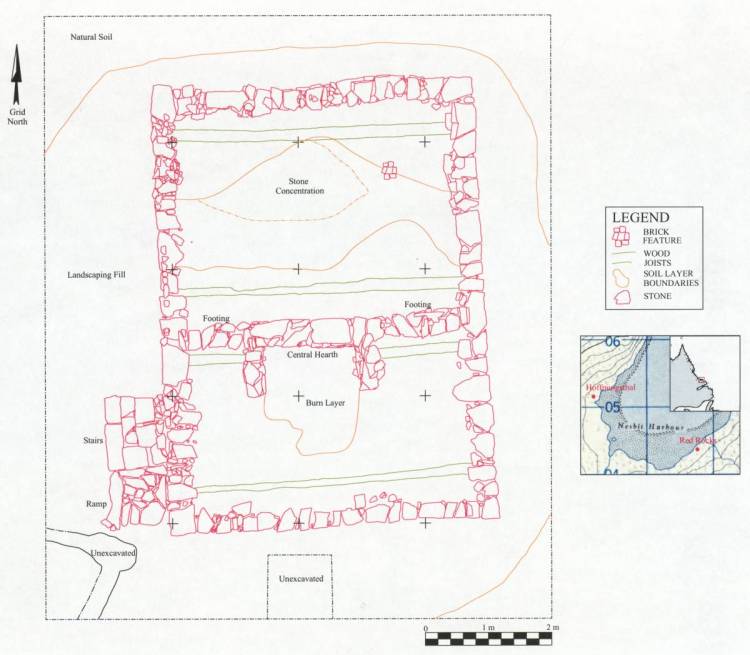
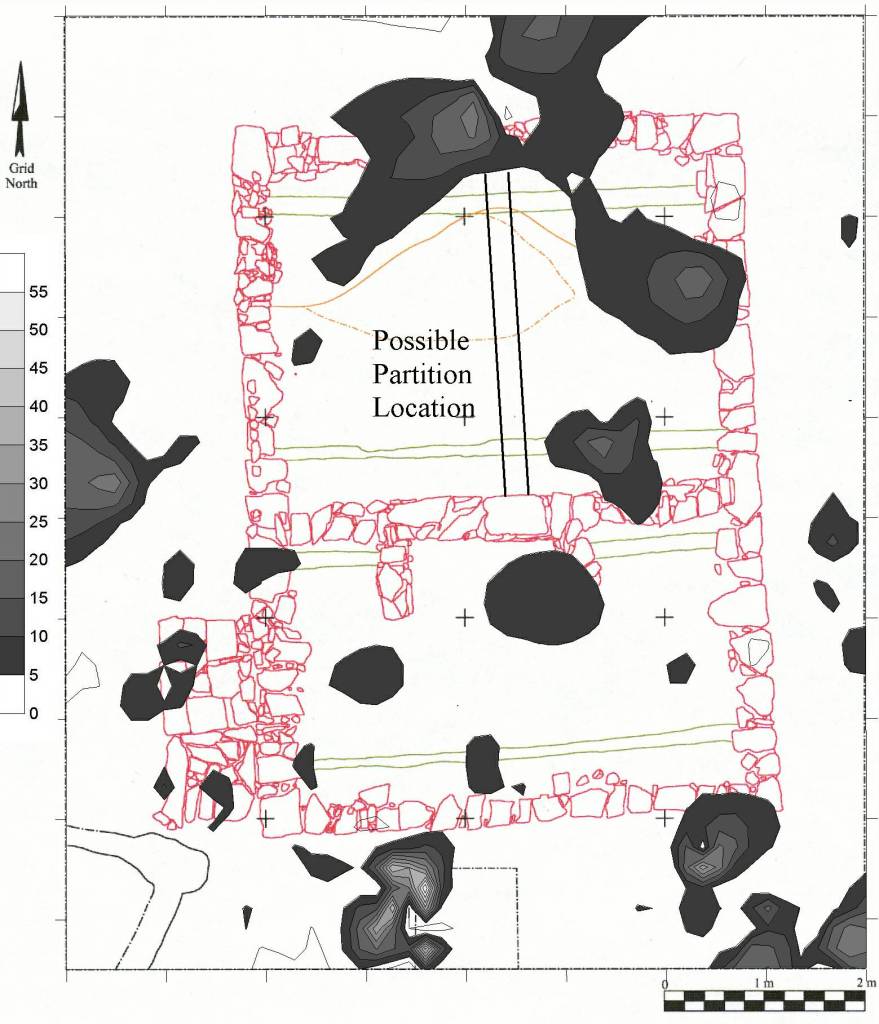
Most of the house interior was obscured by large stones and bricks, but after these were removed a number of well preserved features appeared. Most impressive was an open, “C” shaped hearth made from rough local stones, some measuring up to 40 cm in length. Even after being subject to a black powder explosion followed by two hundred fifty years of neglect, the hearth still stood over 50 cm high. Although most of the hearth was made of stone, the top chimney section had been constructed of brick, as numerous partial and complete bricks were found in the collapsed debris. On either side of the central hearth were two stone footings that essentially divided the house in half and supported interior partitions and doorways. To the north and south and parallel with the footings were five wood stains running east/west across the house interior. These were the remains of joists used to support wooden floorboards.
Plan of the Hoffnungsthal mission remains. (Plan by H. Cary and J. McKay).
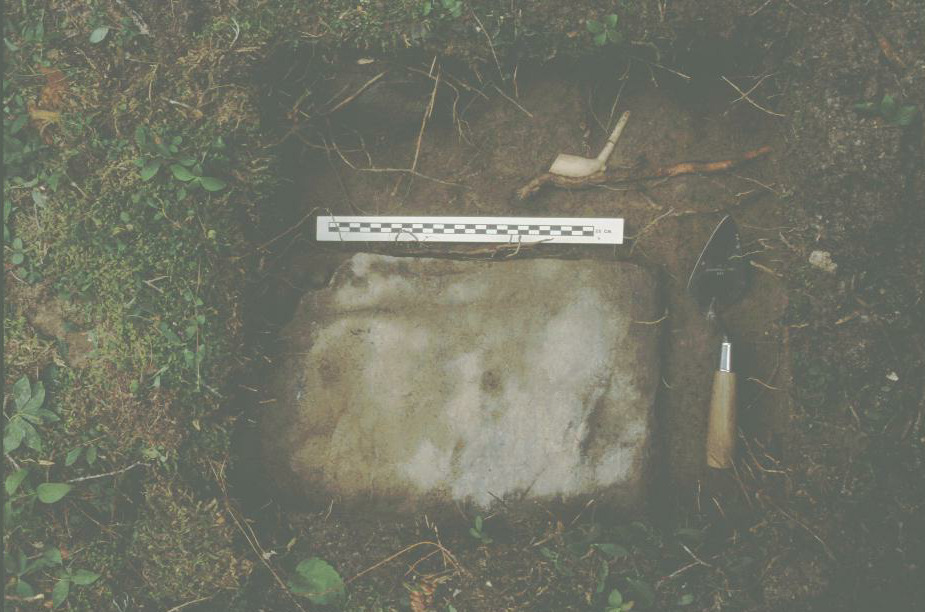
The thousands of artifacts unearthed at Hoffnungsthal provided a good idea of what the missionaries thought necessary for their first year in Labrador. Wrought iron nails, lead shot, window glass, wine bottle fragments, and a wood-handled fork were just some of the items they thought they would need. The most common finds were tobacco pipe bowls and stem fragments. Only two showed any sign of use, and the sheer numbers suggest that at least some of the pipes were to serve as trade goods.
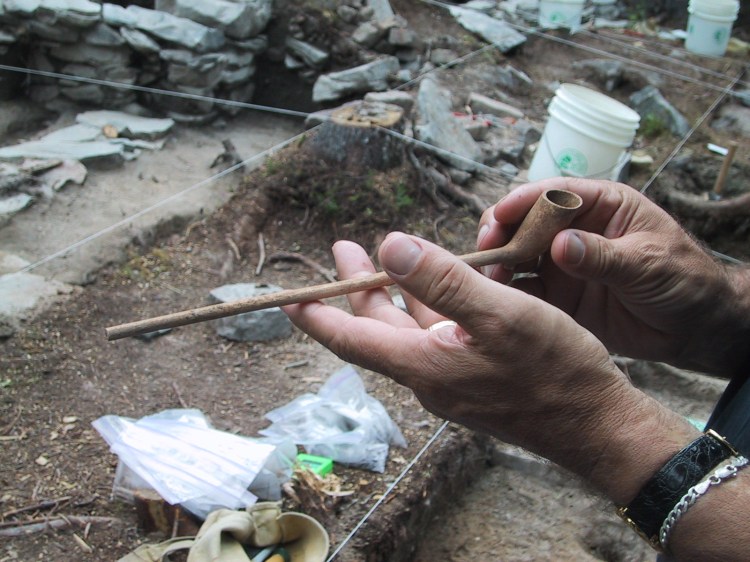
A near complete clay tobacco pipe unearthed in the northeast corner of the house. Hundreds of pipe fragments were recovered during excavations, suggesting that at least some were destined to be trade items for the Inuit (Photo by G. Price).
The archaeological investigations show what the mission house looked like. The floor plan matched a typical off-central chimney design known by the German name of Flurk chenhaus or hall-kitchen house, common throughout Europe and the United States. Although we can only speculate that the house was built in squared log, the archaeological evidence gives a good indication of where the windows on the main floor, and possibly on the roof, had been placed.
A conjectural reconstruction of the Hoffnungsthal mission house based on archaeological and historical data (Photo and reconstruction by H. Cary).

The archaeological findings from Hoffnungsthal have granted an unparalleled picture of the material culture and building styles selected by the Moravians for their missionary expeditions in the mid-eighteenth century.(Henry Cary)
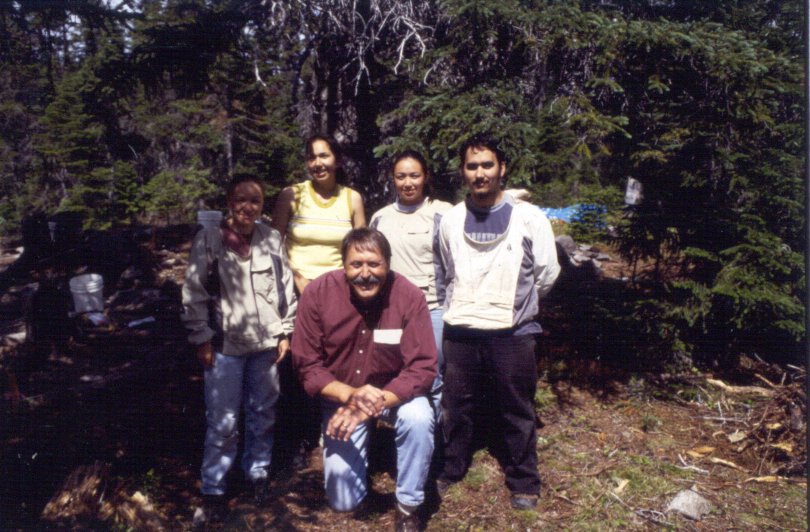
Here are a few more photos of the Nisbet Harbour dig.
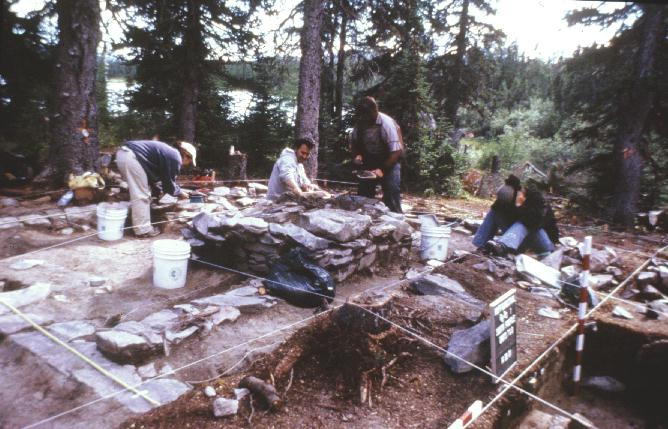
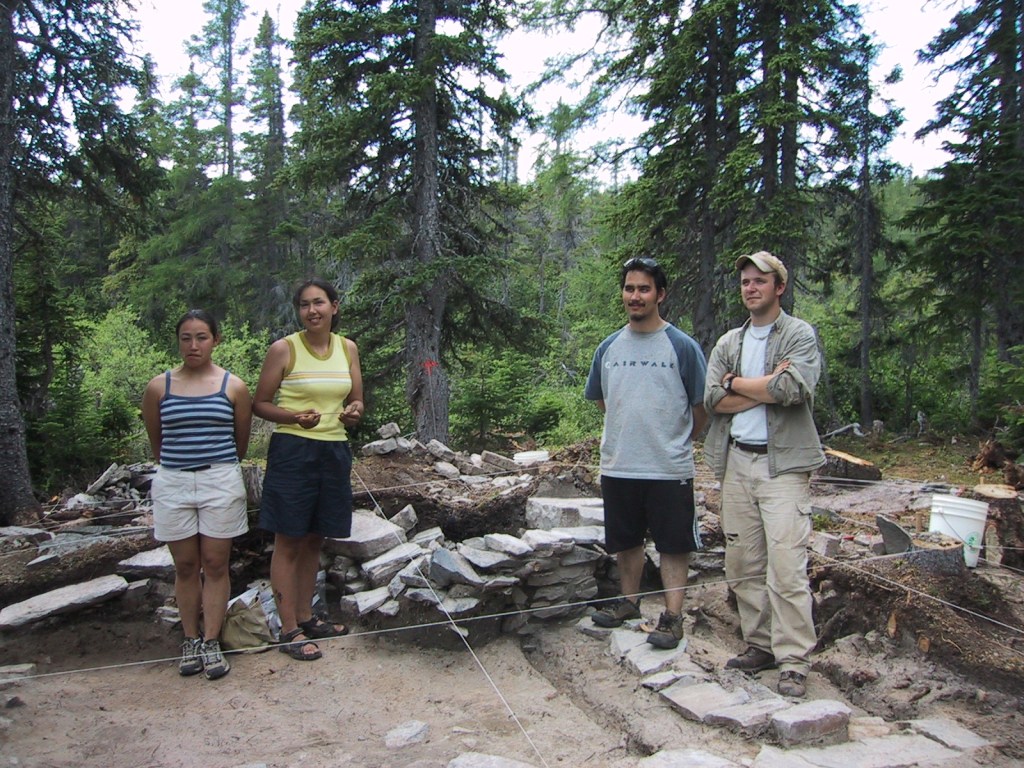
On the behalf of all who worked on this project a special thanks goes out to:
The Provincial Archaeology and Special Celebrations sections of the Department of Tourism, Culture, and Recreation (Government of Newfoundland and Labrador) provided generous financial and personal support for the Hoffnungsthal Archaeological Project from 2000 to 2002. The Newfoundland Archaeological Heritage Outreach Program (NAHOP), funded by the Social Sciences and Humanities Research Council of Canada (SSHRCC), provided money for hiring and support for Makkovik’s initiatives in 2000 and 2001. Support for the 2001 field season and research was provided by the Institute for Social and Economic Research (ISER), the Northern Scientific Training Program (NSTP), and the J.R. Smallwood Foundation.
We would like to thank Henry Cary of Parks Canada Archaeological Services, Military Sites for this summary and photos.
Who was John Christian Erhardt?
Dr. Hans Rollmann is an authority on Moravian history and provides this information…
Johann Christian Erhardt (1718-1752), a German mariner on the Moravian missionary vessel Irene, visited Greenland twice in the 1740’s. He became convinced that the Inuit of North America were related to the ones he had met in New Herrnhut, Greenland, and in 1750 suggested an exploratory voyage to the Inuit of British North America.
The suggested trip became a reality in 1752, when Erhardt undertook a trade and exploratory mission among the Inuit of Labrador together with four missionaries: Georg Wenzeslaus Golkowsky (1725-1813), Johann Christian Krumm (1719-1759), Matthaus Kunz (1722-1774), and Christian Friedrich Post (1715-1785). Count Zinzendorf, the Moravian leader, gave his blessing but insisted on a separation of mission and trade, with Erhardt as trade agent in charge of the business venture. After a difficult voyage through ice and fog, the Hope anchored in a harbour that Erhardt named Nisbet Harbour in honour of their proprietor Claud Nisbet.
Here the missionaries, Erhardt, and some of the ship’s crew built a log house near a small stream and named it Hoffnungsthal, the Valley of Hope. The future Moravian community of Hopedale would be named in its honour. The house was 22 feet long and 16 feet wide, with a living room, kitchen, storeroom, and loft. In the middle was a large stone chimney. The missionaries covered the roof with local juniper bark, glazed the windows, and painted them red. Around the house they even planted a garden with turnips, cabbage, peas, and beans.
Erhardt explored the area, climbing the highest mountains and hiking to a nearby freshwater lake and along a river that flowed from the lake into the neighbouring saltwater bight. On August 14 he observed prophetically that the best settlers for the region would be people from Norway or Sweden, who knew how to work the land. In the nineteenth century, the Norwegian settler Torsten (Kverna) Andersen would become the first permanent European settler of the area.
After supplying the missionaries with goods for a year’s stay. Erhardt went further north with the ship on a trade mission, on which he and six others disappeared during a trade encounter with Inuit. The missionaries at once abandoned their stay and returned home with the vessel. Only the body of one of the men who had been lost was recovered the subsequent year.
Jens Haven, a Danish carpenter and Moravian missionary to Greenland, kept Erhardt’s dream alive. He undertook exploratory voyages for a permanent settlement in 1764, 1765, and 1770. Haven and his wife Mary pioneered missions in Nain (1771), Okak (1776), and Hopedale (1782). On an exploration journey in 1775 for a southern settlement, Jens Haven and two other missionaries, led by Inuit guides, rediscovered the ruins of the first mission house of 1752, which had been destroyed in a fire and explosion. In 2000, the map drawn by Haven and his companions on their 1775 trip helped in locating the foundation of the first mission house.
 White Elephant Museum